
AWS Certified Security Specialty · Free Practice Question Hard
Question 11
A hybrid AWS network is configured to route internet traffic such that it egresses from an on-premises gateway rather than from a VPC Internet Gateway (IGW). Since enabling Amazon GuardDuty, an error has been repeatedly seen in the GuardDuty findings: UnauthorizedAccess:IAMUser/InstanceCredentialExfiltration.OutsideAWS. This finding informs you that a host outside of AWS has attempted to run AWS API operations using temporary AWS credentials that were created on an EC2 instance in your AWS environment. The listed EC2 instance might be compromised, and the temporary credentials from this instance might have been exfiltrated to a remote host outside of AWS.
As a Security engineer, what steps would you take to address this issue, so that the VPC's internet traffic that egresses from an on-premises gateway does not trigger the given error? (Select two)
-
A
Use suppression rules and create a rule that consists of two filter criteria. The first criterion is finding type, which should be
UnauthorizedAccess:EC2/SSHBruteForce -
B
The second filter criterion is
API caller IPv4 addresswith the IP address or CIDR range of the on-premises internet gateway -
C
Use suppression rules and create a rule that consists of two filter criteria. The first criterion is finding type, which should be
UnauthorizedAccess:IAMUser/InstanceCredentialExfiltration.OutsideAWS -
D
Create a finding filter from the GuardDuty console for two different criteria. The first criterion is finding type, which should be
UnauthorizedAccess:IAMUser/InstanceCredentialExfiltration -
E
The second filter criterion is
Trusted IP listto which you add the IP address or CIDR range of the on-premises internet gateway
Reveal correct answers
Correct answers: B, C
Explanation
Correct options:
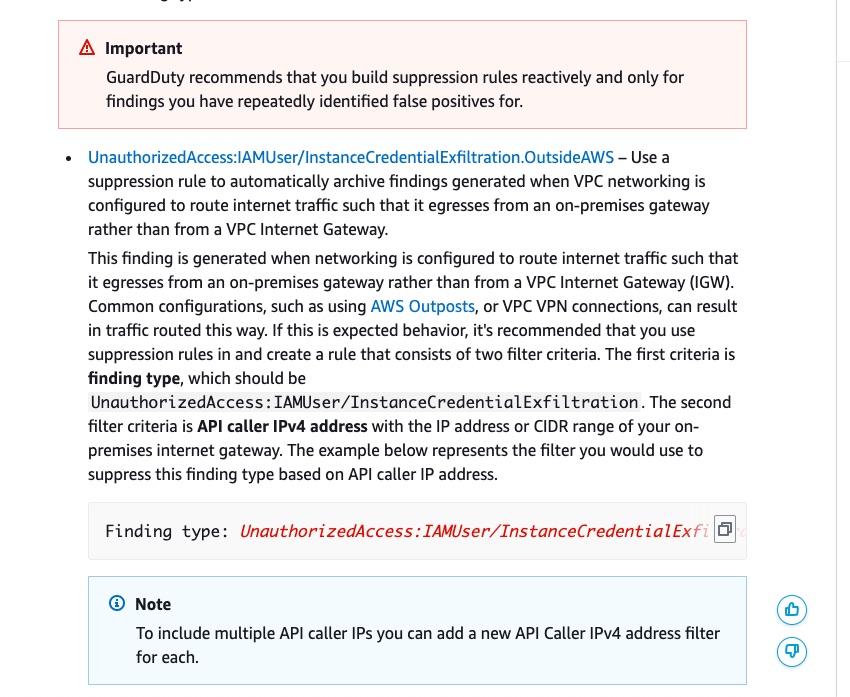
Use suppression rules and create a rule that consists of two filter criteria. The first criterion is finding type, which should be UnauthorizedAccess:IAMUser/InstanceCredentialExfiltration
The second filter criterion is API caller IPv4 address with the IP address or CIDR range of the on-premises internet gateway
A suppression rule is a set of criteria, consisting of a filter attribute paired with a value, used to filter findings by automatically archiving new findings that match the specified criteria. Suppression rules can be used to filter low-value findings, false positive findings, or threats you do not intend to act on, to make it easier to recognize the security threats with the most impact on your environment.
After you create a suppression rule, new findings that match the criteria defined in the rule are automatically archived as long as the suppression rule is in place. You can use an existing filter to create a suppression rule or create a suppression rule from a new filter you define. You can configure suppression rules to suppress entire finding types or define more granular filter criteria to suppress only specific instances of a particular finding type. Your suppression rules can be edited at any time.
GuardDuty continues to generate findings even when they match your suppression rules, however, those findings are automatically marked as archived. The archived finding is stored in GuardDuty for 90 days and can be viewed at any time during that period. You can view suppressed findings in the GuardDuty console by selecting Archived from the findings table, or through the GuardDuty API using the ListFindings API with a findingCriteria criterion of service.archived equal to true.
UnauthorizedAccess:IAMUser/InstanceCredentialExfiltration.OutsideAWS finding informs you that a host outside of AWS has attempted to run AWS API operations using temporary AWS credentials that were created on an EC2 instance in your AWS environment. The listed EC2 instance might be compromised, and the temporary credentials from this instance might have been exfiltrated to a remote host outside of AWS.
However, authorized users can export credentials from their EC2 instances to make legitimate API calls. To rule out a potential attack and verify the legitimacy of the activity, validate if the use of instance credentials from the remote IP in the finding is expected.
Suppression rule for UnauthorizedAccess:IAMUser/InstanceCredentialExfiltration.OutsideAWS:
Incorrect options:
Use suppression rules and create a rule that consists of two filter criteria. The first criterion is finding type, which should be UnauthorizedAccess:EC2/SSHBruteForce - UnauthorizedAccess:EC2/SSHBruteForce is incorrect as it is not relevant to the given use case.
Create a finding filter from the GuardDuty console for two different criteria. The first criterion is finding type, which should be UnauthorizedAccess:IAMUser/InstanceCredentialExfiltration - Creating a finding filter only narrows down the search from the findings created by GuardDuty. A suppression rule is required for this use case, so the GuardDuty findings are immediately archived and not sent for further analysis.
The second filter criterion is Trusted IP list to which you add the IP address or CIDR range of the on-premises internet gateway - Trusted IP lists prevent non-DNS findings from being generated from IPs you consider trusted. This is another important feature (like suppression rules) of GuardDuty to help sort, store, and manage GuardDuty findings. However, this option is not relevant to the given use case.
References:
https://docs.aws.amazon.com/guardduty/latest/ug/findings_suppression-rule.html
Discussion
Think the marked answer is wrong, or have a better explanation? Share it below — comments appear after review.