
Microsoft Certified Azure Data Engineer Associate · Free Practice Question Medium
Question 47
With the wide range of data stores available in Azure, there's the need to manage and orchestrate the movement data between them. In fact, you'll usually want to automate extract, transform, and load (ETL) workloads as a regular process in a wider enterprise analytical solution. Pipelines are a mechanism for defining and orchestrating data movement activities.
Which of the following represents a target in a data flow?
-
A
Drain
-
B
Transformation
-
C
Source
-
D
Faucet
-
E
Supply line
-
F
Sink
Reveal correct answer
Correct answer: F
Explanation
A sink represents a target in a data flow
A source provides the input data for a data flow
You can use various transformations to modify data in a data flow
Faucet, Drain, and Supply line are not valid options
Define data flows
A Data Flow is a commonly used activity type to define data flow and transformation. Data flows consist of:
Sources - The input data to be transferred.
Transformations – Various operations that you can apply to data as it streams through the data flow.
Sinks – Targets into which the data will be loaded.
When you add a Data Flow activity to a pipeline, you can open it in a separate graphical design interface in which to create and configure the required data flow elements.
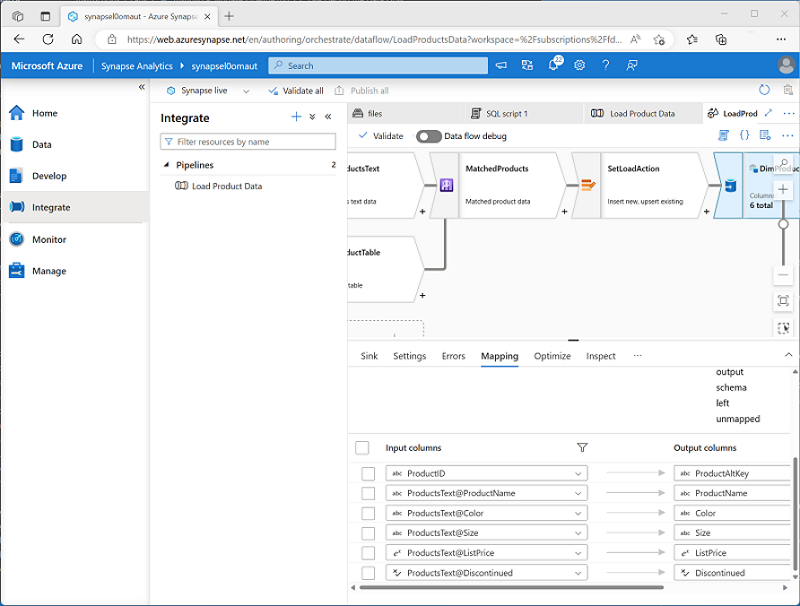
An important part of creating a data flow is to define mappings for the columns as the data flows through the various stages, ensuring column names and data types are defined appropriately. While developing a data flow, you can enable the Data flow debug option to pass a subset of data through the flow, which can be useful to test that your columns are mapped correctly.
A. Faucet and Drain are not standard terms used in data engineering or ETL processes. They do not represent objects in a data flow for defining the target where data is loaded.
B. Transformation is used to modify or manipulate data as it moves through the data flow, but it is not specifically used to define the target where data is loaded. Transformations occur before the data reaches the target.
C. Source represents the origin of the data in a data flow, not the target where the data is loaded. While sources are crucial for extracting data, they are not used to define the destination for data loading.
D. Faucet and Drain are not standard terms used in data engineering or ETL processes. They do not represent objects in a data flow for defining the target where data is loaded.
E. Supply line is not a standard term used in data engineering or ETL processes. It does not represent an object in a data flow for defining the target where data is loaded.
F. A Sink is the correct choice as it represents the target to which data is loaded in a data flow. It defines where the data will be stored or processed after transformation and is an essential component in ETL processes for data movement.
Discussion
Think the marked answer is wrong, or have a better explanation? Share it below — comments appear after review.

