
AWS Certified Solutions Architect Associate · Free Practice Question Easy
Question 22
A Pharmaceuticals company is looking for a simple solution to connect its VPCs and on-premises networks through a central hub.
As a Solutions Architect, which of the following would you suggest as the solution that requires the LEAST operational overhead?
-
A
Fully meshed VPC peering can be used to connect the Amazon VPCs to the on-premises networks
-
B
Use AWS Transit Gateway to connect the Amazon VPCs to the on-premises networks
-
C
Use Transit VPC Solution to connect the Amazon VPCs to the on-premises networks
-
D
Partially meshed VPC peering can be used to connect the Amazon VPCs to the on-premises networks
Reveal correct answer
Correct answer: B
Explanation
Correct option:
Use AWS Transit Gateway to connect the Amazon VPCs to the on-premises networks
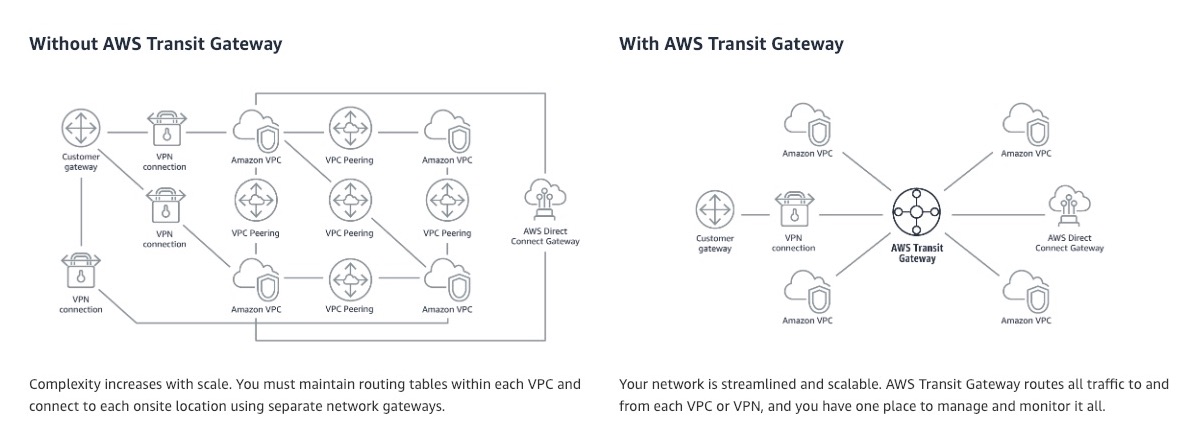
The AWS Transit Gateway allows customers to connect their Amazon VPCs and their on-premises networks to a single gateway. As your number of workloads running on AWS increases, you need to be able to scale your networks across multiple accounts and Amazon VPCs to keep up with the growth. With AWS Transit Gateway, you only have to create and manage a single connection from the central gateway into each Amazon VPC, on-premises data center, or remote office across your network. AWS Transit Gateway acts as a hub that controls how traffic is routed among all the connected networks, which act like spokes. This hub and spoke model simplifies management and reduces operational costs because each network only has to connect to the Transit Gateway and not to every other network.
AWS Transit Gateway:
Incorrect options:
Use Transit VPC Solution to connect the Amazon VPCs to the on-premises networks - The Transit VPC can be used to enable connectivity between various VPC’s in different regions and customer data centers. You can use this to connect multiple VPCs that are geographically disparate and/or running in separate AWS accounts, to a common VPC that serves as a global network transit center. This network topology simplifies network management and minimizes the number of connections that you need to set up.
Transit VPC:
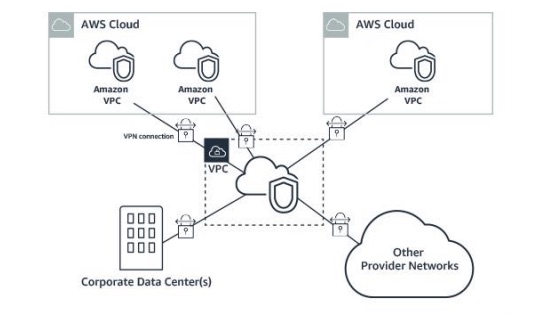
Transit VPC is not the right solution for this use-case as Transit Gateway provides several advantages over Transit VPC: 1. Transit Gateway abstracts away the complexity of maintaining VPN connections with hundreds of VPCs. 2. Transit Gateway removes the need to manage and scale Amazon EC2 based software appliances. AWS is responsible for managing all resources needed to route traffic. 3. Transit Gateway removes the need to manage high availability by providing a highly available and redundant Multi-AZ infrastructure. 4. Transit Gateway improves bandwidth for inter-VPC communication to burst speeds of 50 Gbps per Availability Zone (AZ). 5. Transit Gateway streamlines user costs to a simple per hour per/GB transferred model. 6. Transit Gateway decreases latency by removing Amazon EC2 proxies and the need for VPN encapsulation.
Partially meshed VPC peering can be used to connect the Amazon VPCs to the on-premises networks
Fully meshed VPC peering can be used to connect the Amazon VPCs to the on-premises networks
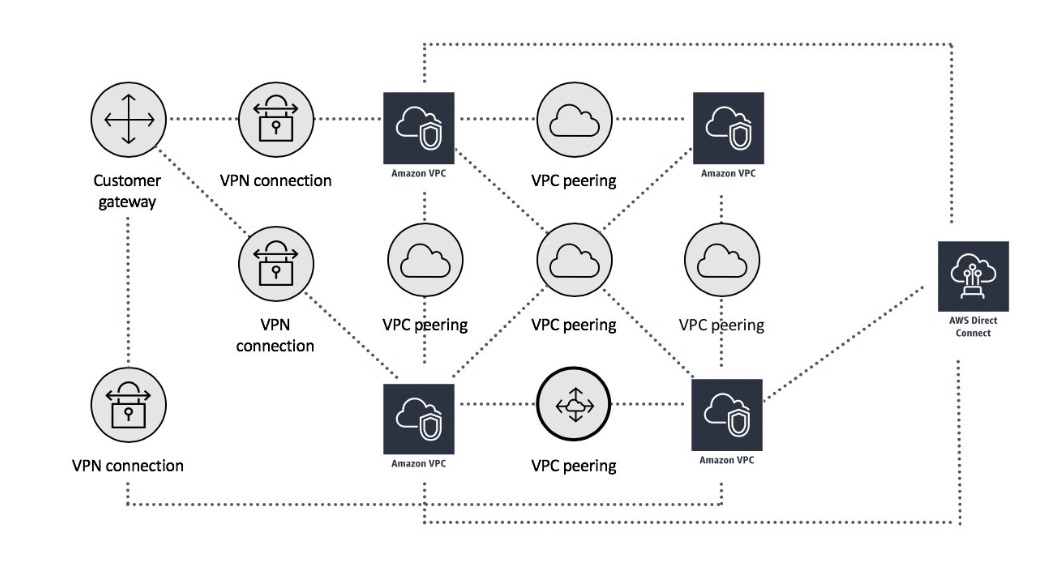
The simplest way to connect two VPCs is to use VPC Peering. In this setup, a connection enables full bidirectional connectivity between the VPCs. This peering connection is used to route traffic between the VPCs. VPCs across accounts and AWS Regions can also be peered together. VPC peering only incurs costs for traffic traveling over the connection (there is no hourly infrastructure fee).
VPC peering is point-to-point connectivity, and it does not support transitive routing. If you are using VPC peering, on-premises connectivity (VPN and/or Direct Connect) must be made to each VPC. Resources in a VPC cannot reach on-premises using the hybrid connectivity of a peered VPC. VPC peering is best used when resources in one VPC must communicate with resources in another VPC, the environment of both VPCs is controlled and secured, and the number of VPCs to be connected is less than 10 (to allow for the individual management of each connection). VPC peering offers the lowest overall cost when compared to other options for inter-VPC connectivity.
Network setup using VPC Peering:
You cannot use VPC Peering to establish on-premises connectivity with AWS Cloud, so both these options are incorrect.
References:
Discussion
Think the marked answer is wrong, or have a better explanation? Share it below — comments appear after review.

