
AWS Certified Solutions Architect Associate · Free Practice Question Medium
Question 20
A social media company wants the capability to dynamically alter the size of a geographic area from which traffic is routed to a specific server resource.
Which feature of Amazon Route 53 can help achieve this functionality?
-
A
Latency-based routing
-
B
Geoproximity routing
-
C
Weighted routing
-
D
Geolocation routing
Reveal correct answer
Correct answer: B
Explanation
Correct option:
Geoproximity routing
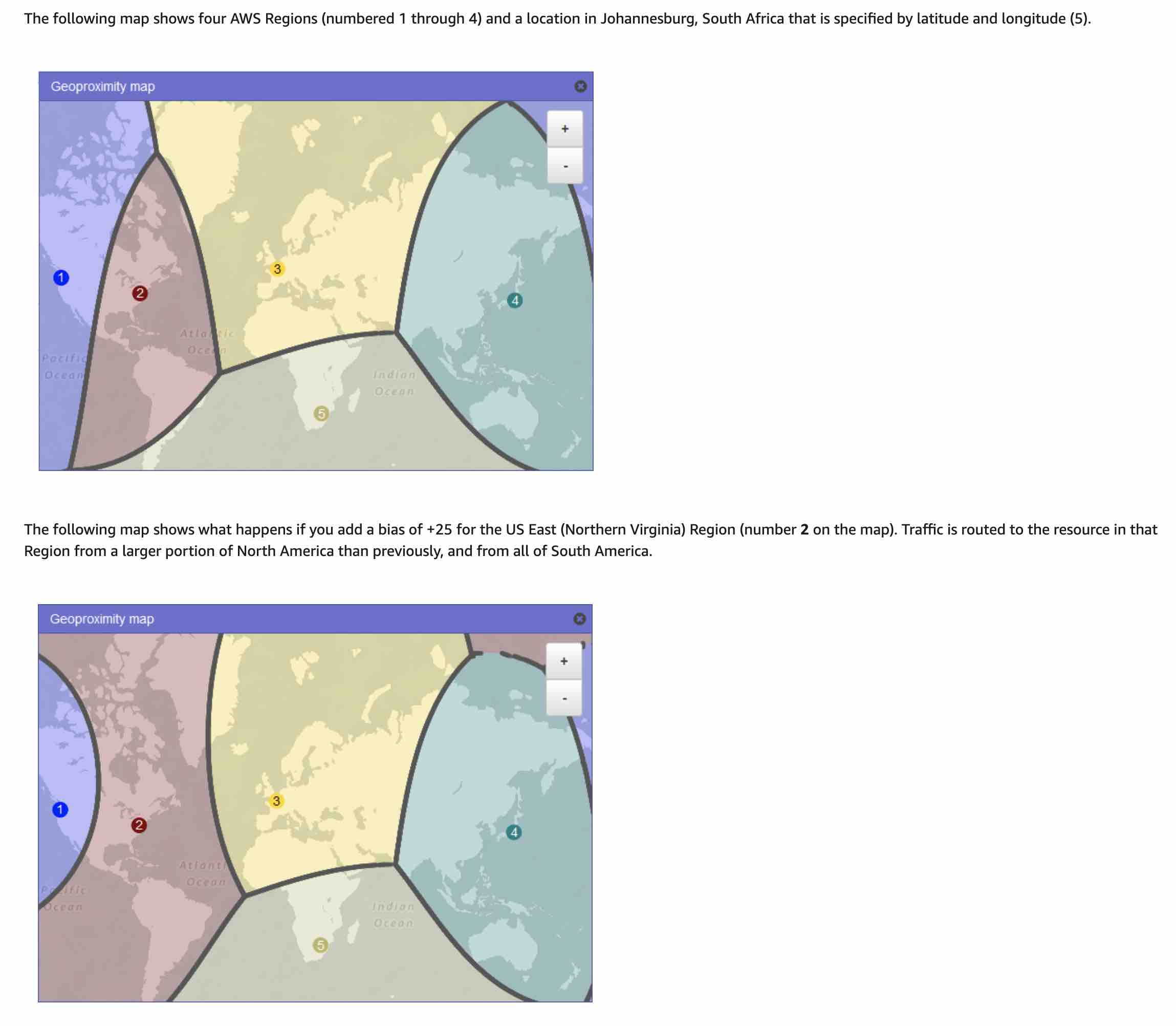
Geoproximity routing lets Amazon Route 53 route traffic to your resources based on the geographic location of your users and your resources. You can also optionally choose to route more traffic or less to a given resource by specifying a value, known as a bias. A bias expands or shrinks the size of the geographic region from which traffic is routed to a resource.
To optionally change the size of the geographic region from which Amazon Route 53 routes traffic to a resource, specify the applicable value for the bias: 1. To expand the size of the geographic region from which Amazon Route 53 routes traffic to a resource, specify a positive integer from 1 to 99 for the bias. Amazon Route 53 shrinks the size of adjacent regions.
- To shrink the size of the geographic region from which Amazon Route 53 routes traffic to a resource, specify a negative bias of -1 to -99. Amazon Route 53 expands the size of adjacent regions.
More on how bias works in Geoproximity routing:
Incorrect options:
Geolocation routing - Geolocation routing lets you choose the resources that serve your traffic based on the geographic location of your users, meaning the location that DNS queries originate from. For example, you might want all queries from Europe to be routed to an Elastic Load Balancing (ELB) load balancer in the Frankfurt region.
When you use geolocation routing, you can localize your content and present some or all of your website in the language of your users. You can also use geolocation routing to restrict the distribution of content to only the locations in which you have distribution rights. Another possible use is for balancing load across endpoints in a predictable, easy-to-manage way so that each user location is consistently routed to the same endpoint.
Latency-based routing - If your application is hosted in multiple AWS Regions, you can improve performance for your users by serving their requests from the AWS Region that provides the lowest latency.
To use latency-based routing, you create latency records for your resources in multiple AWS Regions. When Amazon Route 53 receives a DNS query for your domain or subdomain (example.com or acme.example.com), it determines which AWS Regions you've created latency records for, determines which region gives the user the lowest latency, and then selects a latency record for that region. Amazon Route 53 responds with the value from the selected record, such as the IP address for a web server.
Weighted routing - Weighted routing lets you associate multiple resources with a single domain name (example.com) or subdomain name (acme.example.com) and choose how much traffic is routed to each resource. This can be useful for a variety of purposes, including load balancing and testing new versions of software.
To configure weighted routing, you create records that have the same name and type for each of your resources. You assign each record a relative weight that corresponds with how much traffic you want to send to each resource. Amazon Route 53 sends traffic to a resource based on the weight that you assign to the record as a proportion of the total weight for all records in the group.
Reference:
https://docs.aws.amazon.com/Route53/latest/DeveloperGuide/routing-policy.html
Discussion
Think the marked answer is wrong, or have a better explanation? Share it below — comments appear after review.