
AWS Certified Machine Learning Engineer Associate · Free Practice Question Hard
Question 41
You are a data scientist working for an e-commerce company that wants to implement personalized product recommendations for its users. The company has a large dataset of user interactions, including clicks, purchases, and reviews. The goal is to create a recommendation system that can scale to millions of users while providing real-time recommendations based on user behavior. You need to choose the most appropriate built-in algorithm in Amazon SageMaker to achieve this goal.
Given the requirements, which of the following Amazon SageMaker built-in algorithms is the MOST SUITABLE for this use case?
-
A
Factorization Machines Algorithm to model user-item interactions for collaborative filtering
-
B
BlazingText Algorithm to analyze the text in user reviews and identify product similarities
-
C
K-Means Algorithm to cluster users into segments and recommend products based on these segments
-
D
XGBoost Algorithm to rank the products based on user behavior and demographic features
Reveal correct answer
Correct answer: A
Explanation
Correct option:
Factorization Machines Algorithm to model user-item interactions for collaborative filtering
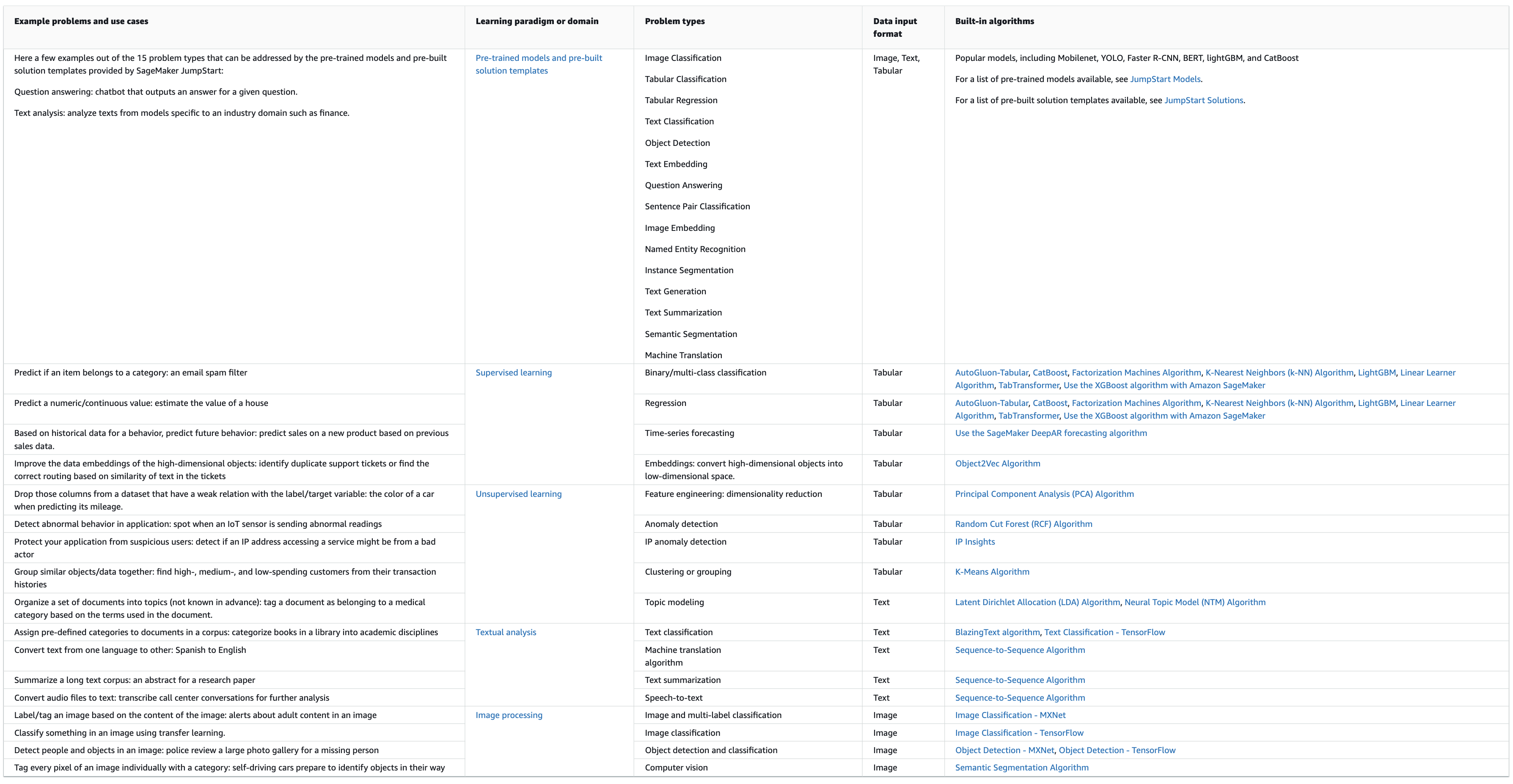
The Factorization Machines algorithm is a general-purpose supervised learning algorithm that you can use for both classification and regression tasks. It is an extension of a linear model that is designed to capture interactions between features within high dimensional sparse datasets economically. For example, in a click prediction system, the Factorization Machines model can capture click rate patterns observed when ads from a certain ad-category are placed on pages from a certain page-category. Factorization machines are a good choice for tasks dealing with high dimensional sparse datasets, such as click prediction and item recommendation.
Factorization Machines is well-suited for collaborative filtering. It excels at modeling sparse user-item interactions, making it ideal for large-scale recommendation systems where there are many users and items but relatively few interactions for each user-item pair. This algorithm can effectively capture latent factors to provide personalized recommendations.
Mapping use cases to built-in algorithms:
Incorrect options:
XGBoost Algorithm to rank the products based on user behavior and demographic features - XGBoost is a powerful algorithm for ranking and classification tasks, but it’s not optimized for collaborative filtering, which is crucial for personalized recommendations in this context.
BlazingText Algorithm to analyze the text in user reviews and identify product similarities - BlazingText is effective for text classification and word embedding but is not specifically designed for recommendation systems. While it can be used to analyze user reviews, it does not address the core requirement of user-item interaction modeling.
K-Means Algorithm to cluster users into segments and recommend products based on these segments - K-Means is useful for clustering users into segments, but this approach is more generalized and does not provide the level of personalization required for individual recommendations based on specific user-item interactions.
References:
https://docs.aws.amazon.com/sagemaker/latest/dg/fact-machines.html
Discussion
Think the marked answer is wrong, or have a better explanation? Share it below — comments appear after review.

