
AWS Certified Developer Associate · Free Practice Question Medium
Question 51
A developer wants to securely store an access token that allows a transaction-processing application running on Amazon EC2 instances to authenticate and send a chat message (via the chat API) to the company's support team when an invalid transaction is detected. While minimizing management overhead, the chat API access token must be encrypted both at rest and in transit, and also be accessible from other AWS accounts.
What is the most efficient solution to address this scenario?
-
A
Leverage SSE-KMS to store the access token as an encrypted object on S3 and configure a resource-based policy for the S3 bucket to allow access from other accounts. Modify the IAM role of the EC2 instances with permissions to access the S3 object. Fetch the token from S3 and then use the decrypted access token to send the message to the chat
-
B
Leverage AWS Systems Manager Parameter Store with an AWS KMS customer-managed key to store the access token as a SecureString parameter and configure a resource-based policy for the parameter to allow access from other accounts. Modify the IAM role of the EC2 instances with permissions to access Parameter Store. Fetch the token from Parameter Store using the
with decryptionflag and then use the decrypted access token to send the message to the chat -
C
Store AWS KMS encrypted access token in a DynamoDB table and configure a resource-based policy for the DynamoDB table to allow access from other accounts. Modify the IAM role of the EC2 instances with permissions to access the DynamoDB table. Fetch the token from the Dynamodb table and then use the decrypted access token to send the message to the chat
-
D
Leverage AWS Secrets Manager with an AWS KMS customer-managed key to store the access token as a secret and configure a resource-based policy for the secret to allow access from other accounts. Modify the IAM role of the EC2 instances with permissions to access Secrets Manager. Fetch the token from Secrets Manager and then use the decrypted access token to send the message to the chat
Reveal correct answer
Correct answer: D
Explanation
Correct option:
Leverage AWS Secrets Manager with an AWS KMS customer-managed key to store the access token as a secret and configure a resource-based policy for the secret to allow access from other accounts. Modify the IAM role of the EC2 instances with permissions to access Secrets Manager. Fetch the token from Secrets Manager and then use the decrypted access token to send the message to the chat
AWS Secrets Manager is an AWS service that encrypts and stores your secrets, and transparently decrypts and returns them to you in plaintext. It's designed especially to store application secrets, such as login credentials, that change periodically and should not be hard-coded or stored in plaintext in the application. In place of hard-coded credentials or table lookups, your application calls Secrets Manager.
Secrets Manager also supports features that periodically rotate the secrets associated with commonly used databases. It always encrypts newly rotated secrets before they are stored.
Secrets Manager integrates with AWS Key Management Service (AWS KMS) to encrypt every version of every secret value with a unique data key that is protected by an AWS KMS key. This integration protects your secrets under encryption keys that never leave AWS KMS unencrypted. It also enables you to set custom permissions on the KMS key and audit the operations that generate, encrypt, and decrypt the data keys that protect your secrets.
To grant permission to retrieve secret values, you can attach policies to secrets or identities.
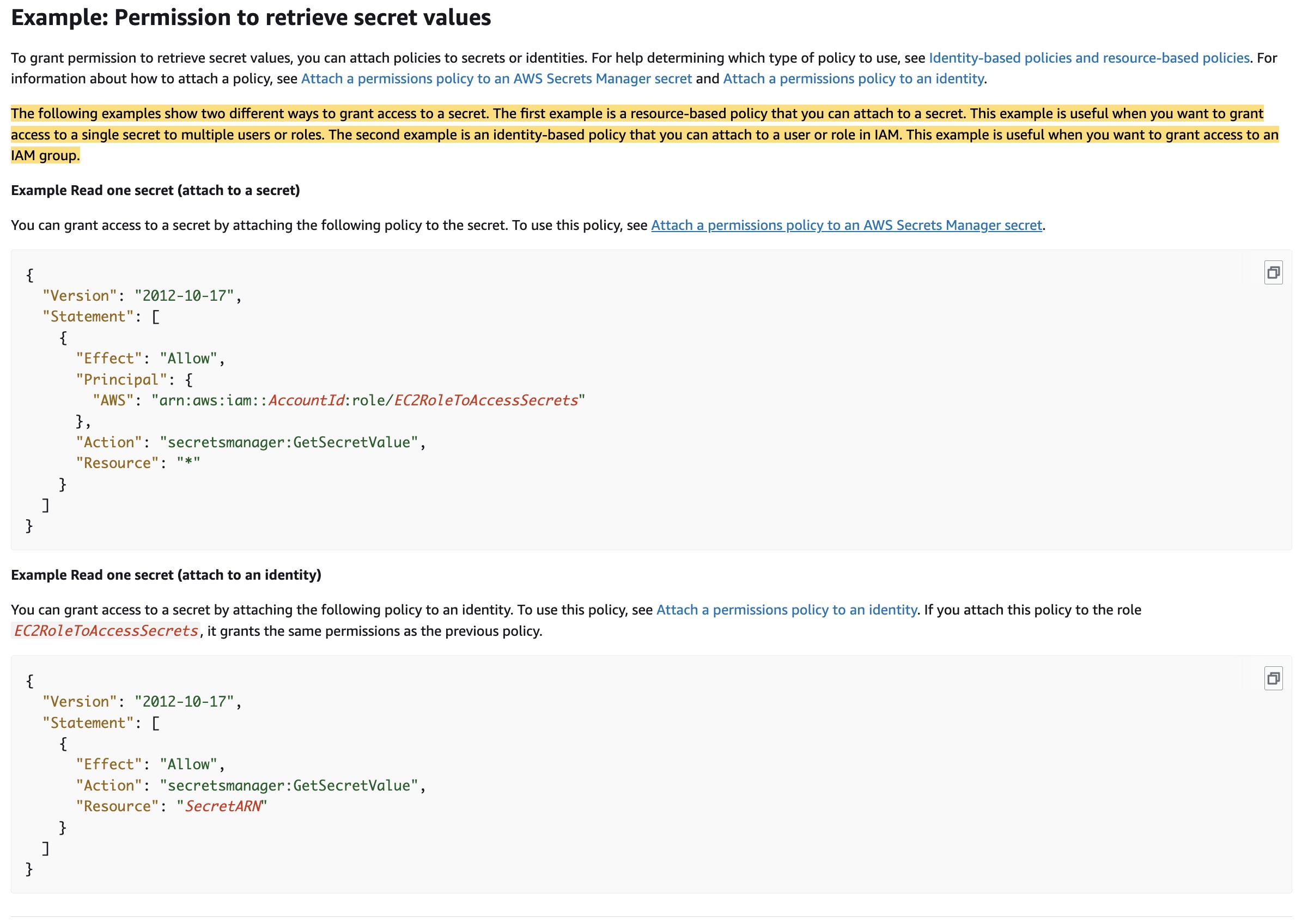
For the given use case, you can use the resource-based policy to the secret to allow access from other accounts. Then you need to update the IAM role of the EC2 instances with permissions to access Secrets Manager which will retrieve the token from Secrets Manager and use the decrypted access token to send the message to the support team via the chat API.
Incorrect options:
Leverage AWS Systems Manager Parameter Store with an AWS KMS customer-managed key to store the access token as a SecureString parameter and configure a resource-based policy for the parameter to allow access from other accounts. Modify the IAM role of the EC2 instances with permissions to access Parameter Store. Fetch the token from Parameter Store using the with decryption flag and then use the decrypted access token to send the message to the chat - You cannot use a resource-based policy with a parameter in the Parameter Store. Parameter Store supports parameter policies that are available for parameters that use the advanced parameters tier. Parameter policies help you manage a growing set of parameters by allowing you to assign specific criteria to a parameter such as an expiration date or time to live. Parameter policies are especially helpful in forcing you to update or delete passwords and configuration data stored in Parameter Store, a capability of AWS Systems Manager. So this option is incorrect.
Store AWS KMS encrypted access token in a DynamoDB table and configure a resource-based policy for the DynamoDB table to allow access from other accounts. Modify the IAM role of the EC2 instances with permissions to access the DynamoDB table. Fetch the token from the Dynamodb table and then use the decrypted access token to send the message to the chat - You should note that DynamoDB does not support resource-based policies. Moreover, it's a security bad practice to keep sensitive access credentials in code, database or a flat file on a file system or object storage. Therefore, this option is incorrect.
Leverage SSE-KMS to store the access token as an encrypted object on S3 and configure a resource-based policy for the S3 bucket to allow access from other accounts. Modify the IAM role of the EC2 instances with permissions to access the S3 object. Fetch the token from S3 and then use the decrypted access token to send the message to the chat - It is considered a security bad practice to keep sensitive access credentials in code, database, or a flat file on a file system or object storage. Therefore, this option is incorrect.
References:
https://docs.aws.amazon.com/secretsmanager/latest/userguide/auth-and-access_examples.html
https://docs.aws.amazon.com/systems-manager/latest/userguide/parameter-store-policies.html
Discussion
Think the marked answer is wrong, or have a better explanation? Share it below — comments appear after review.