
AWS Certified Data Engineer Associate · Free Practice Question Hard
Question 49
A company maintains its datasets in JSON and .csv formats in an Amazon S3 bucket and utilizes Amazon RDS for Microsoft SQL Server, Amazon DynamoDB (in provisioned capacity mode), and an Amazon Redshift cluster. The data engineering team is tasked with creating a solution that enables data scientists to query all these data sources using an SQL-like syntax.
What solution would fulfill these requirements while incurring the least operational overhead and minimizing the costs?
-
A
Leverage AWS Glue to crawl the various data sources and store the resultant metadata in the AWS Glue Data Catalog. Utilize Amazon Redshift Spectrum for querying the data, employing standard SQL for structured data sources and PartiQL for handling data stored in JSON format
-
B
Leverage AWS Glue to crawl the various data sources and store the resultant metadata in the AWS Glue Data Catalog. Utilize Amazon Athena for querying the data, employing standard SQL for structured data sources and PartiQL for handling data stored in JSON format
-
C
Leverage AWS Glue to crawl the various data sources and store the resultant metadata in the AWS Glue Data Catalog. Utilize AWS Glue jobs to transform the JSON data to .csv format and query the resultant data in .csv format using Amazon Athena
-
D
Leverage AWS Glue to crawl the various data sources and store the resultant metadata in the AWS Glue Data Catalog. Utilize AWS Glue jobs to transform both the JSON and .csv format data to parquet format and query the resultant data using Amazon Athena
Reveal correct answer
Correct answer: B
Explanation
Correct option:
Leverage AWS Glue to crawl the various data sources and store the resultant metadata in the AWS Glue Data Catalog. Utilize Amazon Athena for querying the data, employing standard SQL for structured data sources and PartiQL for handling data stored in JSON format
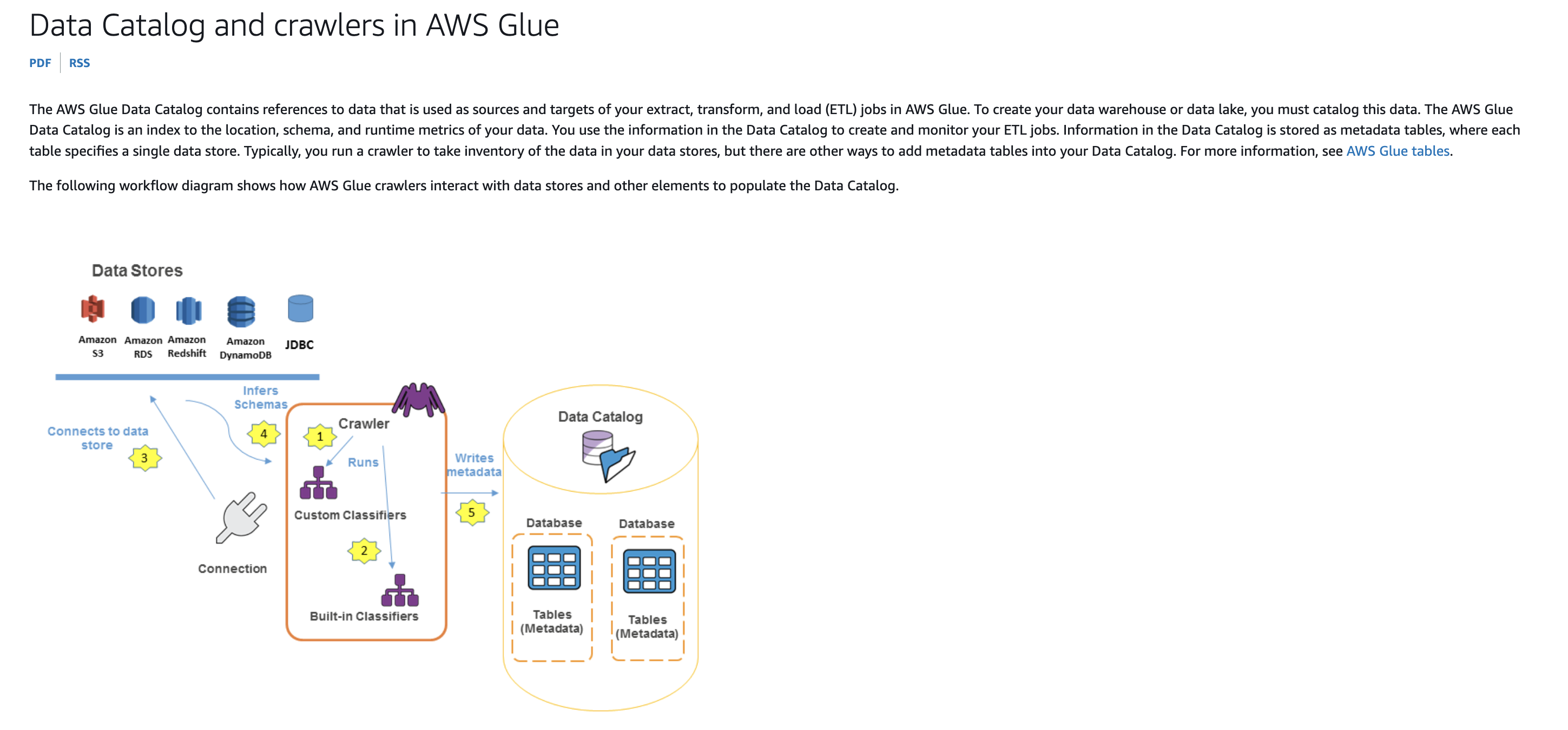
The AWS Glue Data Catalog contains references to data that is used as sources and targets of your extract, transform, and load (ETL) jobs in AWS Glue.
If you have data in sources other than Amazon S3, you can use Athena Federated Query to query the data in place or build pipelines that extract data from multiple data sources and store them in Amazon S3. With Athena Federated Query, you can run SQL queries across data stored in relational, non-relational, object, and custom data sources.
Athena uses data source connectors that run on AWS Lambda to run federated queries. A data source connector is a piece of code that can translate between your target data source and Athena. You can think of a connector as an extension of Athena's query engine. Prebuilt Athena data source connectors exist for data sources like Amazon CloudWatch Logs, Amazon DynamoDB, Amazon DocumentDB, and Amazon RDS, and JDBC-compliant relational data sources such MySQL, and PostgreSQL under the Apache 2.0 license.
Amazon Athena also allows federated query pass-through, which allows entire queries to be executed directly on the underlying data source. Federated query pass-through allows you to take advantage of the unique functions, query language, and performance capabilities of different data sources, and can result in faster query execution and less data processed by Athena. You can run Athena queries on DynamoDB using the PartiQL language. Federated query pass-through is also useful when you want to run SELECT queries that aggregate, join, or invoke functions of your data source that are not available in Athena.
Incorrect options:
Leverage AWS Glue to crawl the various data sources and store the resultant metadata in the AWS Glue Data Catalog. Utilize Amazon Redshift Spectrum for querying the data, employing standard SQL for structured data sources and PartiQL for handling data stored in JSON format - Using Amazon Redshift Spectrum to query the data would involve additional overhead of setting up Redshift spectrum on the existing Redshift cluster. Redshift Spectrum would also turn out to be costlier than Amazon Athena, as it leverages the resources of the Redshift cluster.
Leverage AWS Glue to crawl the various data sources and store the resultant metadata in the AWS Glue Data Catalog. Utilize AWS Glue jobs to transform the JSON data to .csv format and query the resultant data in .csv format using Amazon Athena - Using AWS Glue jobs to transform the JSON data to .csv format represents unnecessary work to build a solution, so this option is incorrect.
Leverage AWS Glue to crawl the various data sources and store the resultant metadata in the AWS Glue Data Catalog. Utilize AWS Glue jobs to transform both the JSON and .csv format data to parquet format and query the resultant data using Amazon Athena - Using AWS Glue jobs to transform both the JSON and .csv format data to parquet format represents unnecessary work to build a solution, so this option is incorrect.
References:
https://docs.aws.amazon.com/athena/latest/ug/connect-to-a-data-source.html
https://aws.amazon.com/about-aws/whats-new/2024/04/amazon-athena-federated-query-pass-through/
https://docs.aws.amazon.com/glue/latest/dg/catalog-and-crawler.html
Discussion
Think the marked answer is wrong, or have a better explanation? Share it below — comments appear after review.