
AWS Certified Data Engineer Associate · Free Practice Question Hard
Question 65
A bank is using Amazon Simple Queue Service (Amazon SQS) to migrate several core banking applications to the cloud to ensure high availability and cost efficiency while simplifying administrative complexity and overhead. The development team at the bank expects a peak rate of about 1000 messages per second to be processed via SQS. It is important that the messages are processed in order.
Which of the following options can be used to implement this system?
-
A
Use Amazon SQS FIFO (First-In-First-Out) queue in batch mode of 4 messages per operation to process the messages at the peak rate
-
B
Use Amazon SQS FIFO (First-In-First-Out) queue in batch mode of 2 messages per operation to process the messages at the peak rate
-
C
Use Amazon SQS FIFO (First-In-First-Out) queue to process the messages
-
D
Use Amazon SQS standard queue to process the messages
Reveal correct answer
Correct answer: A
Explanation
Correct option:
Use Amazon SQS FIFO (First-In-First-Out) queue in batch mode of 4 messages per operation to process the messages at the peak rate
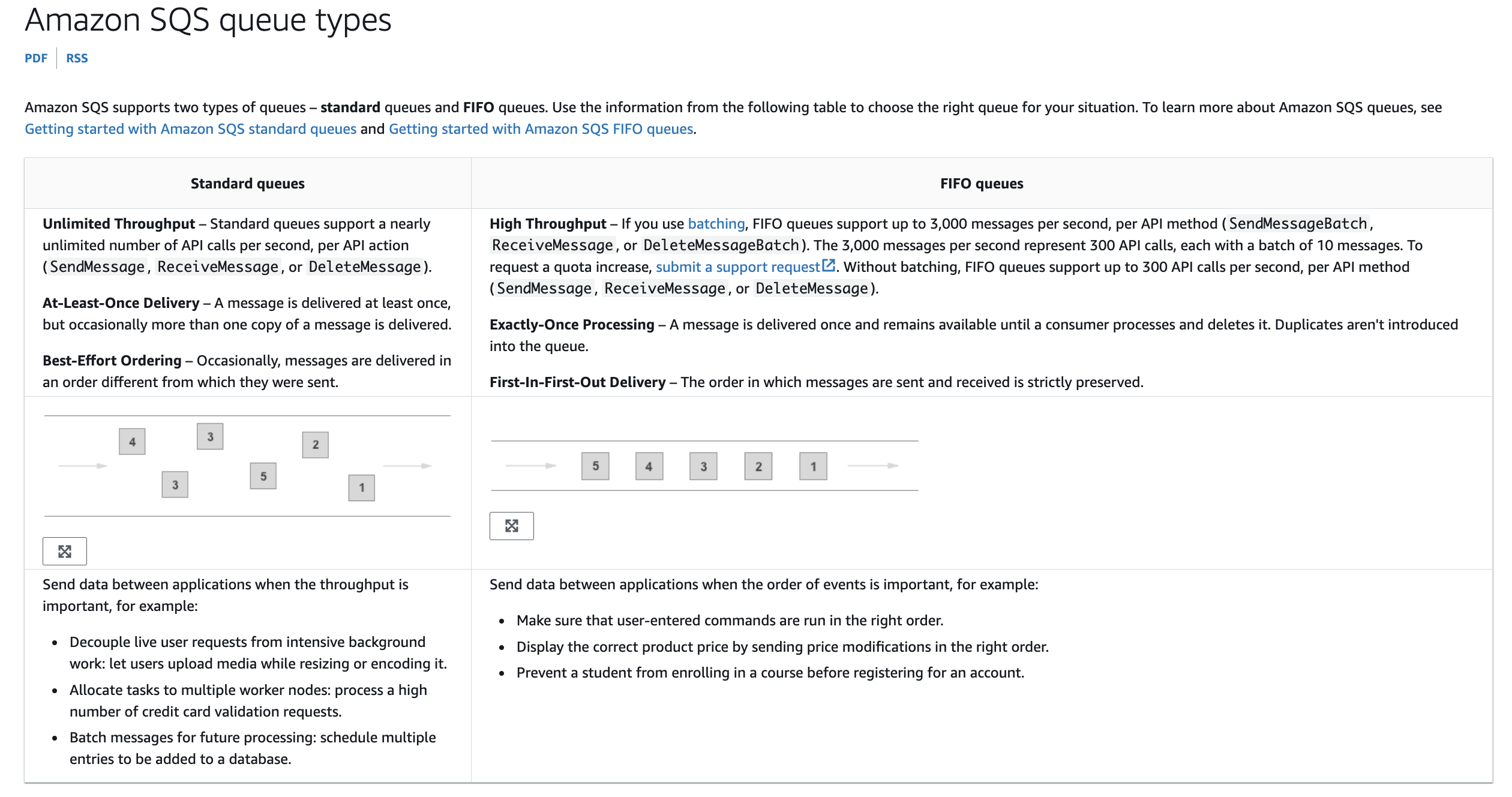
Amazon Simple Queue Service (SQS) is a fully managed message queuing service that enables you to decouple and scale microservices, distributed systems, and serverless applications. SQS offers two types of message queues - Standard queues vs FIFO queues.
For FIFO queues, the order in which messages are sent and received is strictly preserved (i.e. First-In-First-Out). On the other hand, the standard SQS queues offer best-effort ordering. This means that occasionally, messages might be delivered in an order different from which they were sent.
By default, FIFO queues support up to 300 messages per second (300 send, receive, or delete operations per second). When you batch 10 messages per operation (maximum), FIFO queues can support up to 3,000 messages per second. Therefore you need to process 4 messages per operation so that the FIFO queue can support up to 1200 messages per second, which is well within the peak rate.
Incorrect options:
Use Amazon SQS standard queue to process the messages - As messages need to be processed in order, therefore standard queues are ruled out.
Use Amazon SQS FIFO (First-In-First-Out) queue to process the messages - By default, FIFO queues support up to 300 messages per second and this is not sufficient to meet the message processing throughput per the given use case. Hence this option is incorrect.
Use Amazon SQS FIFO (First-In-First-Out) queue in batch mode of 2 messages per operation to process the messages at the peak rate - As mentioned earlier in the explanation, you need to use FIFO queues in batch mode and process 4 messages per operation, so that the FIFO queue can support up to 1200 messages per second. With 2 messages per operation, you can only support up to 600 messages per second.
References:
Discussion
Think the marked answer is wrong, or have a better explanation? Share it below — comments appear after review.

