
AWS Certified Data Engineer Associate · Free Practice Question Medium
Question 1
A media agency stores its re-creatable assets on Amazon Simple Storage Service (Amazon S3) buckets. The assets are accessed by a large number of users for the first few days and the frequency of access falls down drastically after a week. Although the assets would be accessed occasionally after the first week, they must continue to be immediately accessible when required. The cost of maintaining all the assets on Amazon S3 storage is turning out to be very expensive and the agency is looking at reducing costs as much as possible.
Can you suggest a way to lower the storage costs while fulfilling the business requirements?
-
A
Configure a lifecycle policy to transition the objects to Amazon S3 One Zone-Infrequent Access (S3 One Zone-IA) after 30 days
-
B
Configure a lifecycle policy to transition the objects to Amazon S3 Standard-Infrequent Access (S3 Standard-IA) after 7 days
-
C
Configure a lifecycle policy to transition the objects to Amazon S3 Standard-Infrequent Access (S3 Standard-IA) after 30 days
-
D
Configure a lifecycle policy to transition the objects to Amazon S3 One Zone-Infrequent Access (S3 One Zone-IA) after 7 days
Reveal correct answer
Correct answer: A
Explanation
Correct option:
Configure a lifecycle policy to transition the objects to Amazon S3 One Zone-Infrequent Access (S3 One Zone-IA) after 30 days
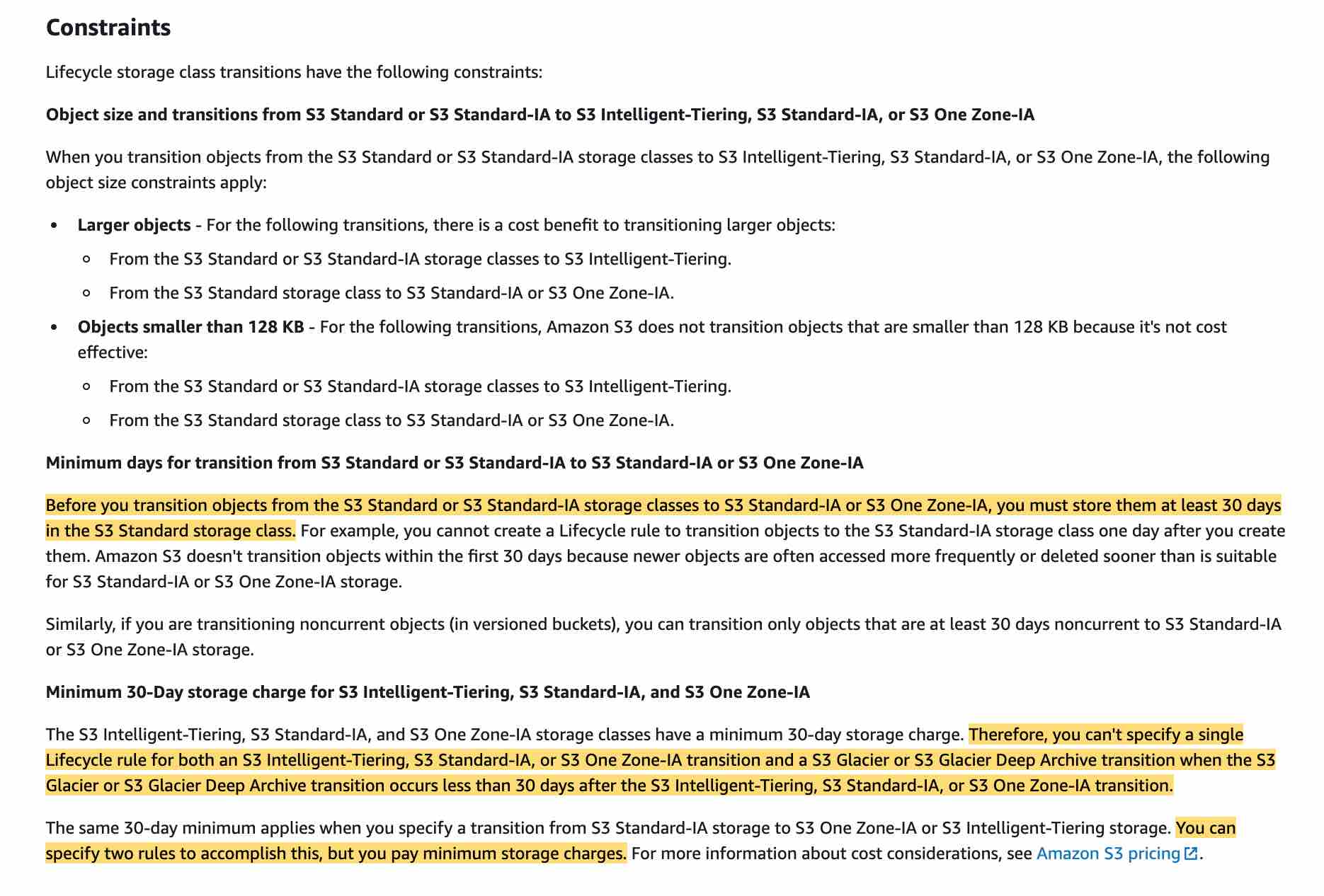
Amazon S3 One Zone-IA is for data that is accessed less frequently but requires rapid access when needed. Unlike other S3 Storage Classes which store data in a minimum of three Availability Zones (AZs), Amazon S3 One Zone-IA stores data in a single Availability Zone (AZ) and costs 20% less than Amazon S3 Standard-IA. Amazon S3 One Zone-IA is ideal for customers who want a lower-cost option for infrequently accessed and re-creatable data but do not require the availability and resilience of Amazon S3 Standard or Amazon S3 Standard-IA. The minimum storage duration is 30 days before you can transition objects from Amazon S3 Standard to Amazon S3 One Zone-IA.
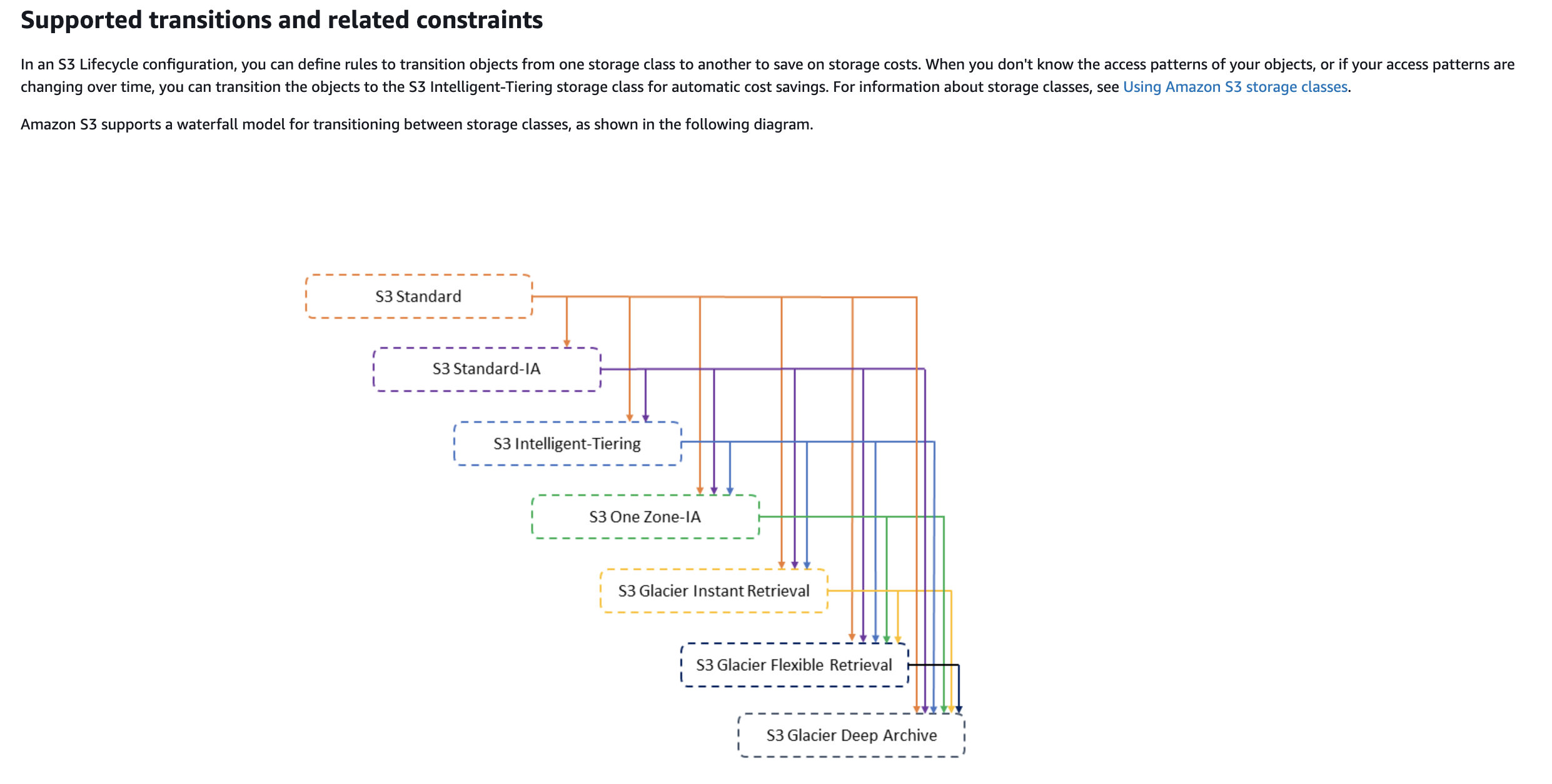
Amazon S3 One Zone-IA offers the same high durability, high throughput, and low latency of Amazon S3 Standard, with a low per GB storage price and per GB retrieval fee. S3 Storage Classes can be configured at the object level, and a single bucket can contain objects stored across Amazon S3 Standard, Amazon S3 Intelligent-Tiering, Amazon S3 Standard-IA, and Amazon S3 One Zone-IA. You can also use S3 Lifecycle policies to automatically transition objects between storage classes without any application changes.
Constraints for Lifecycle storage class transitions:
Supported Amazon S3 lifecycle transitions:
Incorrect options:
Configure a lifecycle policy to transition the objects to Amazon S3 Standard-Infrequent Access (S3 Standard-IA) after 7 days
Configure a lifecycle policy to transition the objects to Amazon S3 One Zone-Infrequent Access (S3 One Zone-IA) after 7 days
As mentioned earlier, the minimum storage duration is 30 days before you can transition objects from Amazon S3 Standard to Amazon S3 One Zone-IA or Amazon S3 Standard-IA, so both these options are added as distractors.
Configure a lifecycle policy to transition the objects to Amazon S3 Standard-Infrequent Access (S3 Standard-IA) after 30 days - Amazon S3 Standard-IA is for data that is accessed less frequently but requires rapid access when needed. S3 Standard-IA offers the high durability, high throughput, and low latency of Amazon S3 Standard, with a low per GB storage price and per GB retrieval fee. This combination of low cost and high performance makes Amazon S3 Standard-IA ideal for long-term storage, backups, and as a data store for disaster recovery files. However, it costs more than Amazon S3 One Zone-IA because of the redundant storage across Availability Zones (AZs). As the data is re-creatable, so you don't need to incur this additional cost.
References:
https://aws.amazon.com/s3/storage-classes/
https://docs.aws.amazon.com/AmazonS3/latest/dev/lifecycle-transition-general-considerations.html
Discussion
Think the marked answer is wrong, or have a better explanation? Share it below — comments appear after review.

