
AWS Certified Developer Associate · Free Practice Question Medium
Question 61
A company wants to share information with a third party via an HTTP API endpoint managed by the third party. The company has the necessary API key to access the endpoint and the integration of the API key with the company's application code must not impact the application's performance.
What is the most secure approach?
-
A
Keep the API credentials in a local code variable and use the local code variable at runtime to make the API call
-
B
Keep the API credentials in an encrypted file in S3 and use the credentials to make the API call by fetching the API credentials from S3 at runtime by using the AWS SDK
-
C
Keep the API credentials in an encrypted table in MySQL RDS and use the credentials to make the API call by fetching the API credentials from RDS at runtime by using the AWS SDK
-
D
Keep the API credentials in AWS Secrets Manager and use the credentials to make the API call by fetching the API credentials at runtime by using the AWS SDK
Reveal correct answer
Correct answer: D
Explanation
Correct option:
Keep the API credentials in AWS Secrets Manager and use the credentials to make the API call by fetching the API credentials at runtime by using the AWS SDK
Secrets Manager enables you to replace hardcoded credentials in your code, including passwords, with an API call to Secrets Manager to retrieve the secret programmatically. This helps ensure the secret can't be compromised by someone examining your code, because the secret no longer exists in the code. Also, you can configure Secrets Manager to automatically rotate the secret for you according to a specified schedule. This enables you to replace long-term secrets with short-term ones, significantly reducing the risk of compromise.
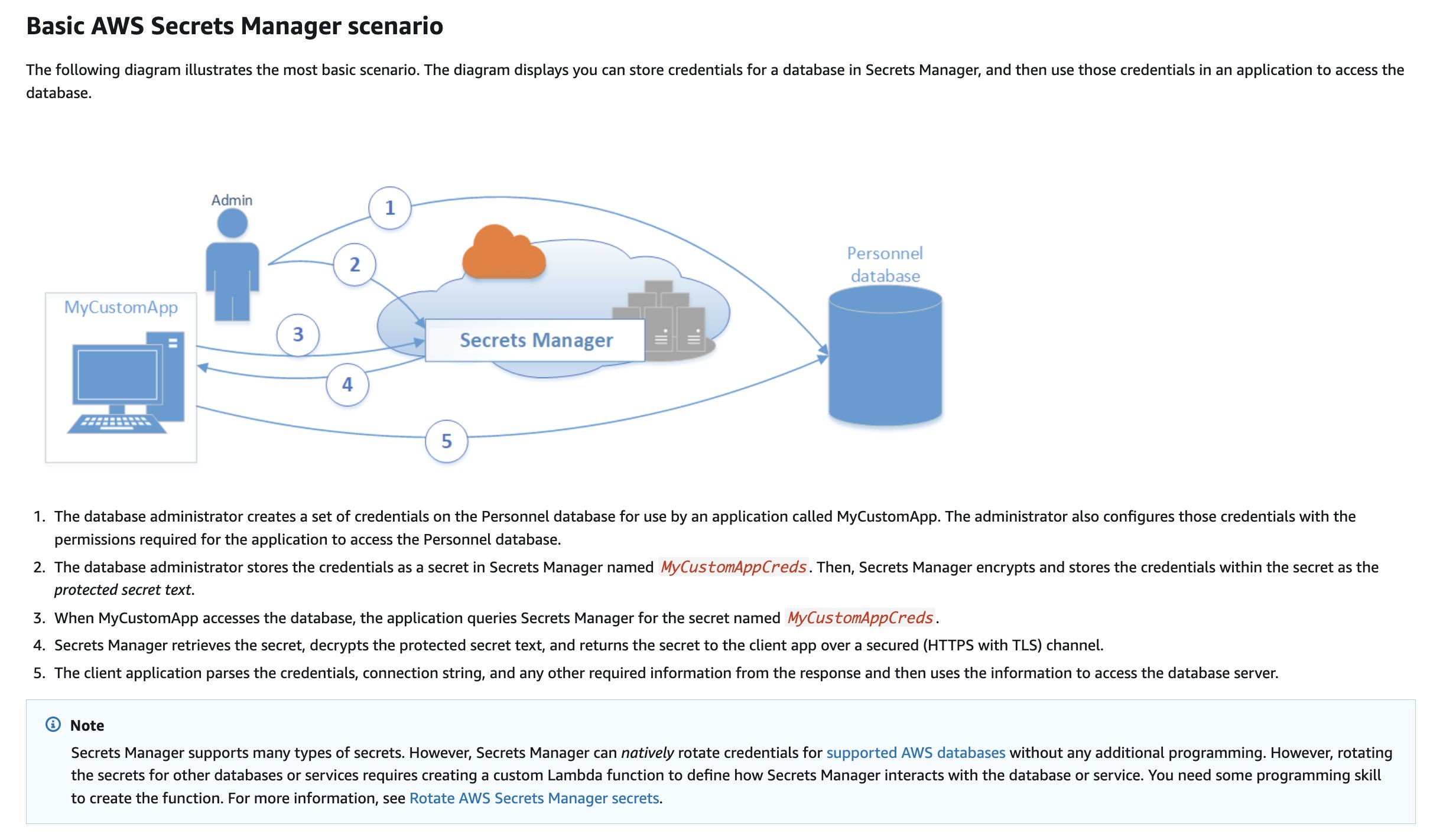
In the past, when you created a custom application to retrieve information from a database, you typically embedded the credentials, the secret, for accessing the database directly in the application. When the time came to rotate the credentials, you had to do more than just create new credentials. You had to invest time to update the application to use the new credentials. Then you distributed the updated application. If you had multiple applications with shared credentials and you missed updating one of them, the application failed. Because of this risk, many customers choose not to regularly rotate credentials, which effectively substitutes one risk for another. You can also use caching with Secrets Manager to significantly improve the availability and latency of applications.
Incorrect options:
Keep the API credentials in an encrypted table in MySQL RDS and use the credentials to make the API call by fetching the API credentials from RDS at runtime by using the AWS SDK
Keep the API credentials in an encrypted file in S3 and use the credentials to make the API call by fetching the API credentials from S3 at runtime by using the AWS SDK
Keep the API credentials in a local code variable and use the local code variable at runtime to make the API call
It is considered a security bad practice to keep sensitive access credentials in code, database, or a flat file on a file system or object storage. Therefore, all three options are incorrect.
References:
https://docs.aws.amazon.com/secretsmanager/latest/userguide/intro.html
Discussion
Think the marked answer is wrong, or have a better explanation? Share it below — comments appear after review.

