
AWS Certified AI Practitioner · Free Practice Question Medium
Question 20
A media company is deploying machine learning models using Amazon SageMaker to generate personalized content recommendations. Since the company has intermittent workloads and it does not want to configure or manage the underlying infrastructure, the development team is evaluating different deployment models that offer cost savings by allowing for cold starts. Understanding which deployment model suits this use case will help them balance cost efficiency with operational needs.
What do you suggest?
-
A
Asynchronous Inference
-
B
Serverless Inference
-
C
Batch transform
-
D
Real-time hosting services
Reveal correct answer
Correct answer: B
Explanation
Correct option:
Serverless Inference
On-demand Serverless Inference is ideal for workloads that have idle periods between traffic spurts and can tolerate cold starts.
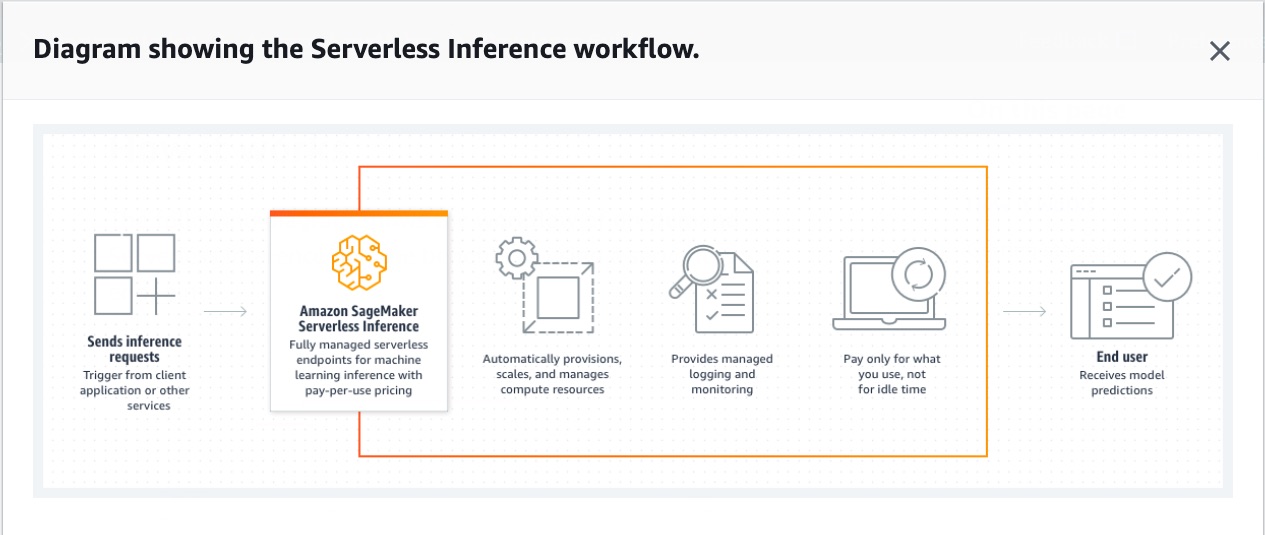
Amazon SageMaker Serverless Inference is a purpose-built inference option that enables you to deploy and scale ML models without configuring or managing any of the underlying infrastructure.
Serverless endpoints automatically launch compute resources and scale them in and out depending on traffic, eliminating the need to choose instance types or manage scaling policies. This takes away the undifferentiated heavy lifting of selecting and managing servers. Serverless Inference integrates with AWS Lambda to offer you high availability, built-in fault tolerance, and automatic scaling. With Serverless Inference, you can quickly deploy machine learning models for inference without having to configure or manage the underlying infrastructure, and you pay only for the compute capacity used to process inference requests, which is ideal for intermittent workloads. During times when there are no requests, Serverless Inference scales your endpoint down to 0, helping you to minimize your costs.
Serverless Inference:
Incorrect options:
Asynchronous Inference - Asynchronous Inference is used for requests with large payload sizes up to 1GB, long processing times, and near real-time latency requirements.
Batch transform - To get predictions for an entire dataset, use SageMaker batch transform.
Real-time hosting services - For persistent, real-time endpoints that make one prediction at a time, use SageMaker real-time hosting services.
References:
https://docs.aws.amazon.com/sagemaker/latest/dg/how-it-works-deployment.html
Discussion
Think the marked answer is wrong, or have a better explanation? Share it below — comments appear after review.