
Microsoft Certified Power Platform Functional Consultant Associate · Free Practice Question Hard
Question 44
Scenario: Café Rivoli is a restaurant in Manhattan which has very exclusive clientele. Steve Rogers and Bruce Banner are the creators of this iconic restaurant and continue to strive to improve the business. Part of the improvements have been to implement Microsoft Dataverse into their business and have hired you to lead several projects in the company.
At this time, the project at hand is dealing with Dataverse database table design.
The team needs to design an Azure Synapse Analytics dedicated SQL pool that meets the following requirements.
Required:
Can return an employee record from a given point in time
Maintains the latest employee information
Minimizes query complexity
How should the team model the employee data?
-
A
As a SQL graph table
-
B
As a degenerate dimension table
-
C
As a temporal table
-
D
As a Type 2 slowly changing dimension (SCD) table
Reveal correct answer
Correct answer: D
Explanation
A Type 2 SCD supports versioning of dimension members. Often the source system doesn't store versions, so the data warehouse load process detects and manages changes in a dimension table. In this case, the dimension table must use a surrogate key to provide a unique reference to a version of the dimension member. It also includes columns that define the date range validity of the version (for example, StartDate and EndDate) and possibly a flag column (for example, IsCurrent) to easily filter by current dimension members.
Choose between slowly changing dimension types
Star schema design theory refers to common SCD types. The most common are Type 1 and Type 2. In practice a dimension table may support a combination of history tracking methods, including Type 3 and Type 6. Let's get to know the difference in these SCD types.
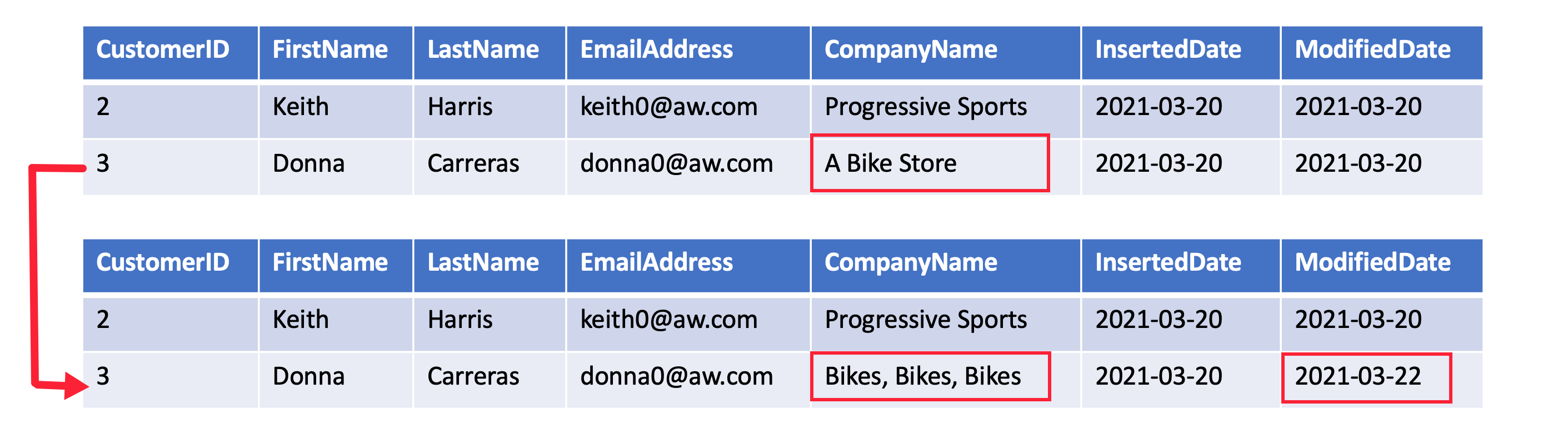
Type 1 SCD
A Type 1 SCD always reflects the latest values, and when changes in source data are detected, the dimension table data is overwritten. This design approach is common for columns that store supplementary values, like the email address or phone number of a customer. When a customer email address or phone number changes, the dimension table updates the customer row with the new values. It's as if the customer always had this contact information. The key field, such as CustomerID, would stay the same so the records in the fact table automatically link to the updated customer record.
Type 2 SCD
A Type 2 SCD supports versioning of dimension members. Often the source system doesn't store versions, so the data warehouse load process detects and manages changes in a dimension table. In this case, the dimension table must use a surrogate key to provide a unique reference to a version of the dimension member. It also includes columns that define the date range validity of the version (for example, StartDate and EndDate) and possibly a flag column (for example, IsCurrent) to easily filter by current dimension members.
For example, a company assigns salespeople to a sales region. When a salesperson relocates region, a new version of the salesperson must be created to ensure that historical facts remain associated with the former region. To support accurate historic analysis of sales by salesperson, the dimension table must store versions of salespeople and their associated region(s). The table should also include start and end date values to define the time validity. Current versions may define an empty end date (or 12/31/9999), which indicates that the row is the current version. The table must also define a surrogate key because the business key (in this instance, employee ID) won't be unique.
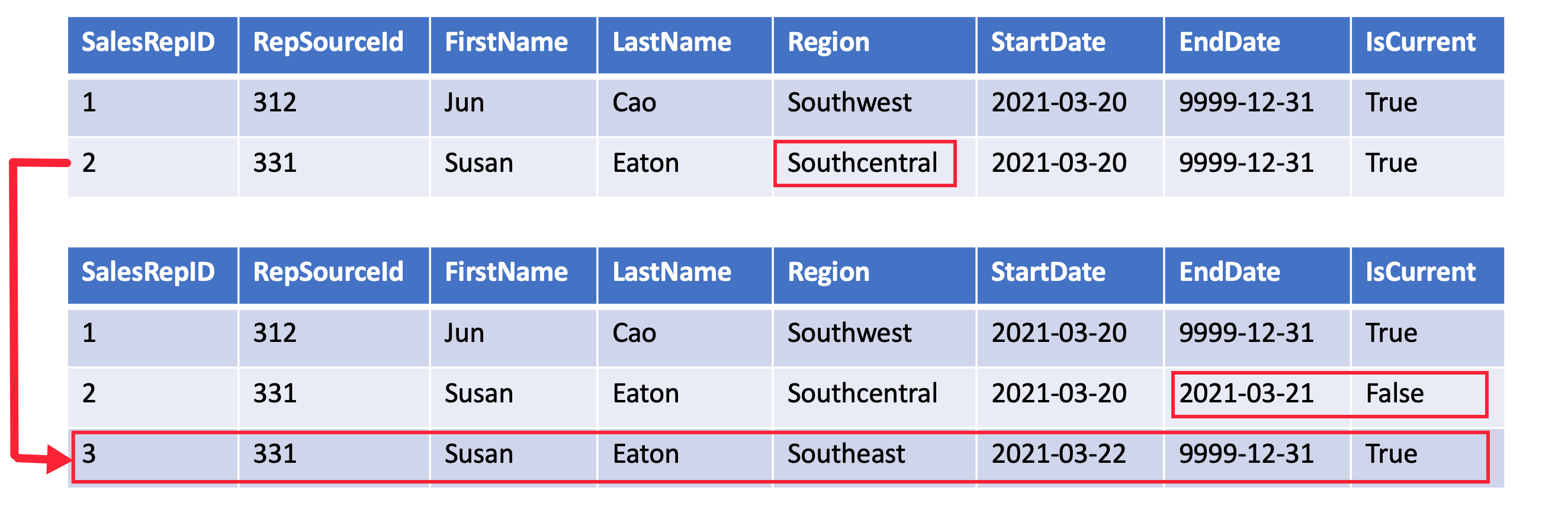
It's important to understand that when the source data doesn't store versions, you must use an intermediate system (like a data warehouse) to detect and store changes. The table load process must preserve existing data and detect changes. When a change is detected, the table load process must expire the current version. It records these changes by updating the EndDate value and inserting a new version with the StartDate value commencing from the previous EndDate value. Also, related facts must use a time-based lookup to retrieve the dimension key value relevant to the fact date.
Type 3 SCD
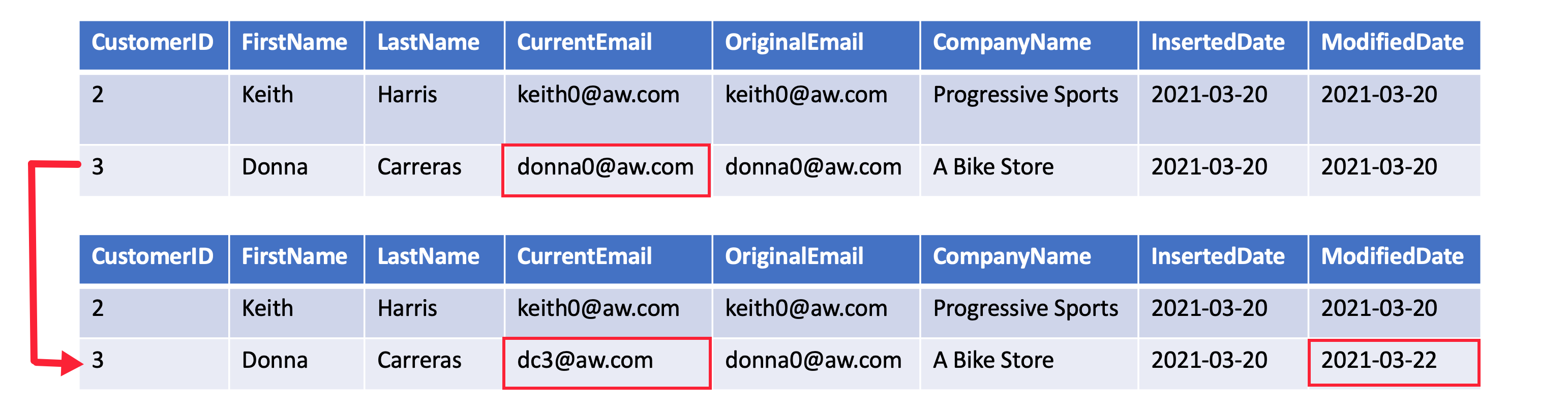
A Type 3 SCD supports storing two versions of a dimension member as separate columns. The table includes a column for the current value of a member plus either the original or previous value of the member. So Type 3 uses additional columns to track one key instance of history, rather than storing additional rows to track each change like in a Type 2 SCD.
This type of tracking may be used for one or two columns in a dimension table. It is not common to use it for many members of the same table. It is often used in combination with Type 1 or Type 2 members.
Type 6 SCD
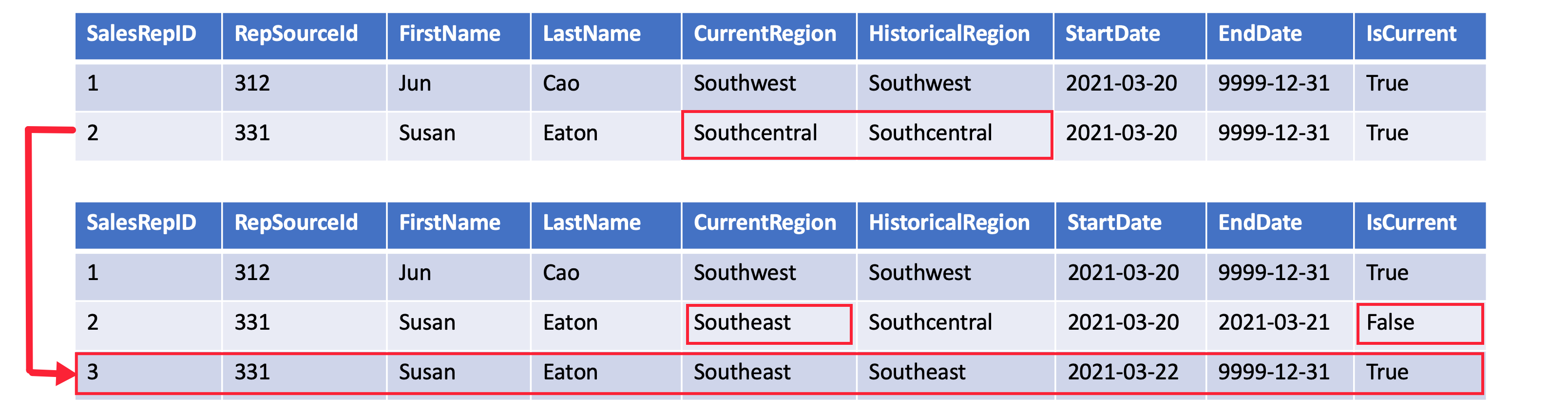
A Type 6 SCD combines Type 1, 2, and 3. When a change happens to a Type 2 member you create a new row with appropriate StartDate and EndDate. In Type 6 design you also store the current value in all versions of that entity so you can easily report on the current value or the historical value.
Using the sales region example, you split the Region column into CurrentRegion and HistoricalRegion. The CurrentRegion always shows the latest value and the HistoricalRegion shows the region that was valid between the StartDate and EndDate. So for the same salesperson, every record would have the latest region populated in CurrentRegion while HistoricalRegion works exactly like the region field in the Type 2 SCD example.
A. Modeling the employee data as a SQL graph table is not the most appropriate choice for this scenario. SQL graph tables are typically used to represent complex relationships between data entities, such as social networks or hierarchical structures. In this case, the focus is on maintaining employee records and querying them efficiently, which can be better achieved through a Type 2 slowly changing dimension (SCD) table.
B. Modeling the employee data as a degenerate dimension table is not suitable for this scenario. Degenerate dimension tables are typically used to store attributes that do not fit into the existing dimension tables in a data warehouse. However, in this case, the requirement is to design a table that can return an employee record from a given point in time and maintain the latest information, which is better achieved through a Type 2 slowly changing dimension (SCD) table.
C. Modeling the employee data as a temporal table is not the best choice for this scenario. While temporal tables can track historical changes to data, they are more suited for auditing purposes rather than returning records from a specific point in time. Additionally, temporal tables may introduce unnecessary complexity to the query process, which goes against the requirement of minimizing query complexity.
D. Modeling the employee data as a Type 2 slowly changing dimension (SCD) table is the correct choice because it allows for historical tracking of changes to employee records over time. This design meets the requirement of being able to return an employee record from a given point in time while also maintaining the latest employee information. By using SCD, the team can minimize query complexity and easily track changes to employee data.
Discussion
Think the marked answer is wrong, or have a better explanation? Share it below — comments appear after review.