
AWS Certified Solutions Architect Associate · Free Practice Question Medium
Question 2
A genomics research firm is processing sporadic bursts of data-intensive workloads using Amazon EC2 instances. The shared storage must support unpredictable spikes in file operations, but the average daily throughput demand remains relatively low. The team has selected Amazon Elastic File System (EFS) for its scalability and wants to ensure optimal cost and performance during bursts without provisioning throughput manually.
Which approach should the team take to best meet these requirements?
-
A
Enable EFS Infrequent Access (IA) storage class to reduce storage cost while continuing to benefit from burst throughput mode
-
B
Enable EFS burst throughput mode on the file system using the General Purpose performance mode and EFS Standard storage class
-
C
Switch the EFS storage class to EFS One Zone to reduce cost, which will automatically enable burst throughput mode
-
D
Change the throughput mode to provisioned and configure the desired throughput value to support burst workloads
Reveal correct answer
Correct answer: B
Explanation
Correct option:
Enable EFS burst throughput mode on the file system using the General Purpose performance mode and EFS Standard storage class
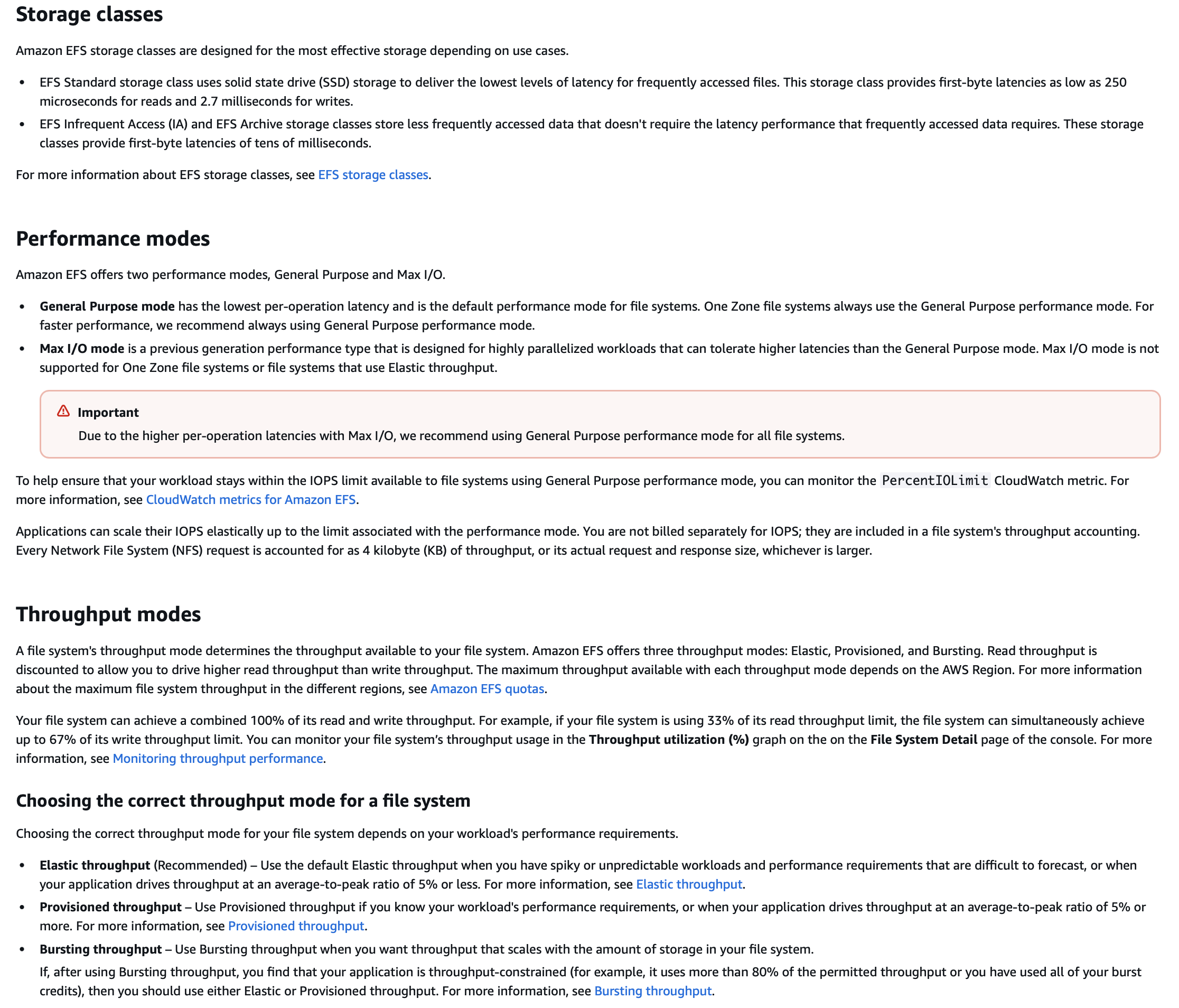
Enabling burst throughput mode on an Amazon EFS file system using the General Purpose performance mode and the EFS Standard storage class is the most effective approach for workloads with sporadic spikes in throughput demand but low average usage. In burst throughput mode, which is enabled by default for EFS file systems smaller than 1 TiB, EFS accumulates and consumes throughput credits that allow the system to burst to higher levels of throughput as needed—without requiring manual intervention. This mode is ideal for unpredictable workloads like genomics analysis, where short periods of intense activity are followed by idle time. Importantly, using the EFS Standard storage class ensures high availability across multiple Availability Zones, aligning with best practices for fault-tolerant and latency-sensitive environments.
Incorrect options:
Switch the EFS storage class to EFS One Zone to reduce cost, which will automatically enable burst throughput mode - Switching to the EFS One Zone storage class does not automatically enable burst throughput mode. While One Zone reduces costs by storing data in a single Availability Zone, it is unrelated to throughput mode configuration. Burst throughput can still be used with One Zone, but enabling One Zone alone doesn't guarantee that the file system will operate in burst mode. The throughput mode must be explicitly set to burst or provisioned, and One Zone should only be used when high availability across AZs is not a requirement.
Change the throughput mode to provisioned and configure the desired throughput value to support burst workloads - Switching to provisioned throughput mode contradicts the requirement of not manually managing throughput. Provisioned mode allows specifying a fixed throughput level regardless of file system size, which can be useful for consistent high-throughput workloads but adds unnecessary cost and management overhead for workloads with low average throughput and occasional bursts. Burst throughput mode is better suited here since it automatically scales with usage patterns and does not require manual configuration.
Enable EFS Infrequent Access (IA) storage class to reduce storage cost while continuing to benefit from burst throughput mode - Enabling the EFS Infrequent Access (IA) storage class is useful for reducing cost on rarely accessed files but has no impact on throughput mode. Moreover, once files are transitioned to IA, they may incur retrieval latency and additional costs when accessed during a burst, which may negatively impact performance. Also, to revert files from IA back to Standard, you must disable lifecycle management, but this change is not automatic. Relying on IA for burst performance is not appropriate and may lead to suboptimal behavior.
References:
Discussion
Think the marked answer is wrong, or have a better explanation? Share it below — comments appear after review.