
AWS Certified Sysops Administrator Associate · Free Practice Question Medium
Question 14
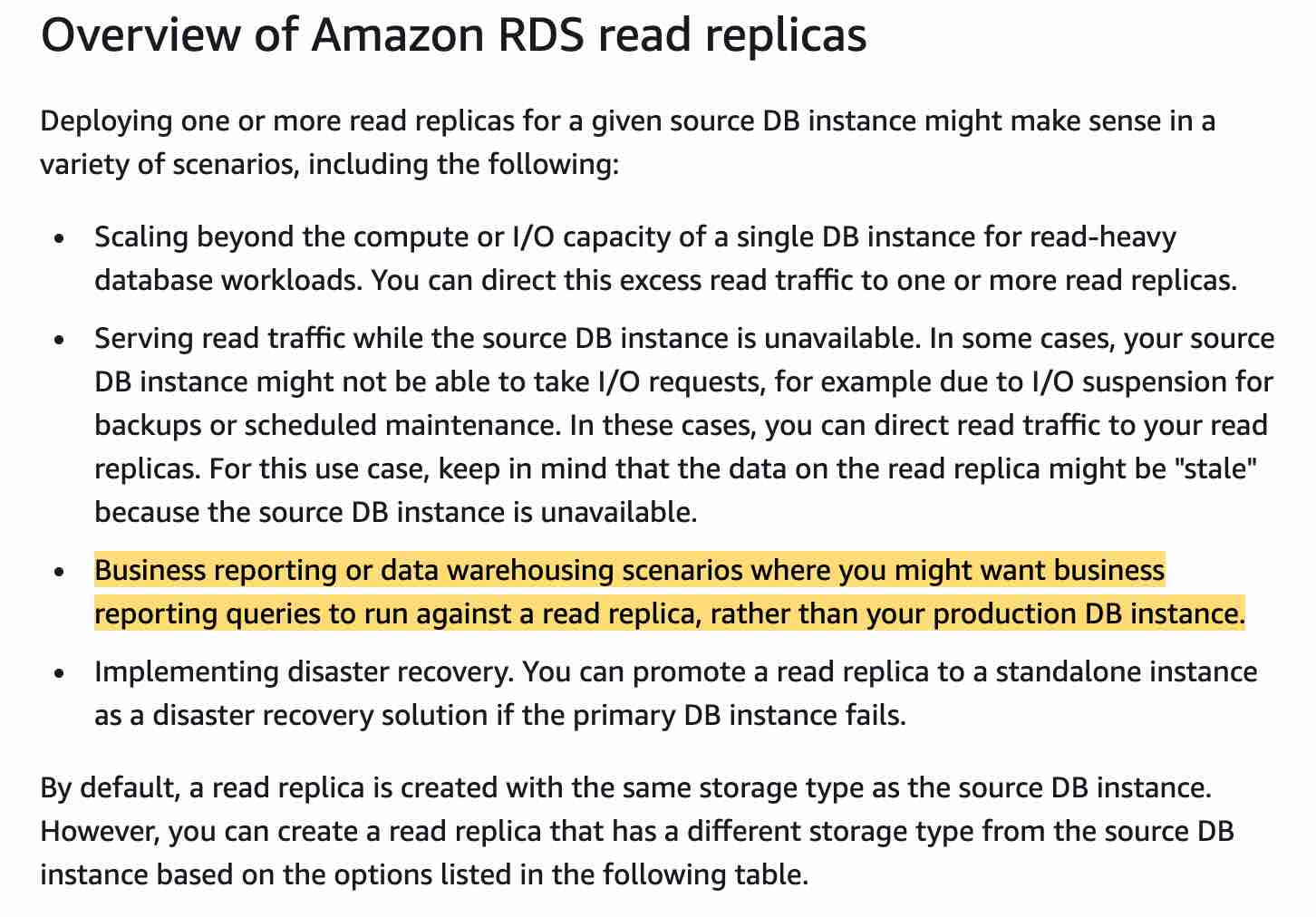
The Big Data team at an insurance company is performing a nightly ETL on top of your production RDS database to compute a view and then extract it into their data lake in Amazon S3. This query has been performing reasonably well in your website's infancy but now that it has grown in popularity, the query is running for a much longer period and affects the user experience while they browse your website.
How can you improve the situation in the short and long term?
-
A
Upgrade the RDS instance type
-
B
Create an RDS Read Replica for the ETL team
-
C
Use Athena to query RDS
-
D
Enable RDS Multi-AZ
Reveal correct answer
Correct answer: B
Explanation
Correct option:
Create an RDS Read Replica for the ETL team
Amazon RDS Read Replicas provide enhanced performance and durability for RDS database (DB) instances. They make it easy to elastically scale out beyond the capacity constraints of a single DB instance for read-heavy database workloads. For the MySQL, MariaDB, PostgreSQL, Oracle, and SQL Server database engines, Amazon RDS creates a second DB instance using a snapshot of the source DB instance. It then uses the engines' native asynchronous replication to update the read replica whenever there is a change to the source DB instance.
For the given use-case, you can use one or more read replicas for the given source DB instance as the source for the ETL process to populate the data lake on S3.
Incorrect options:
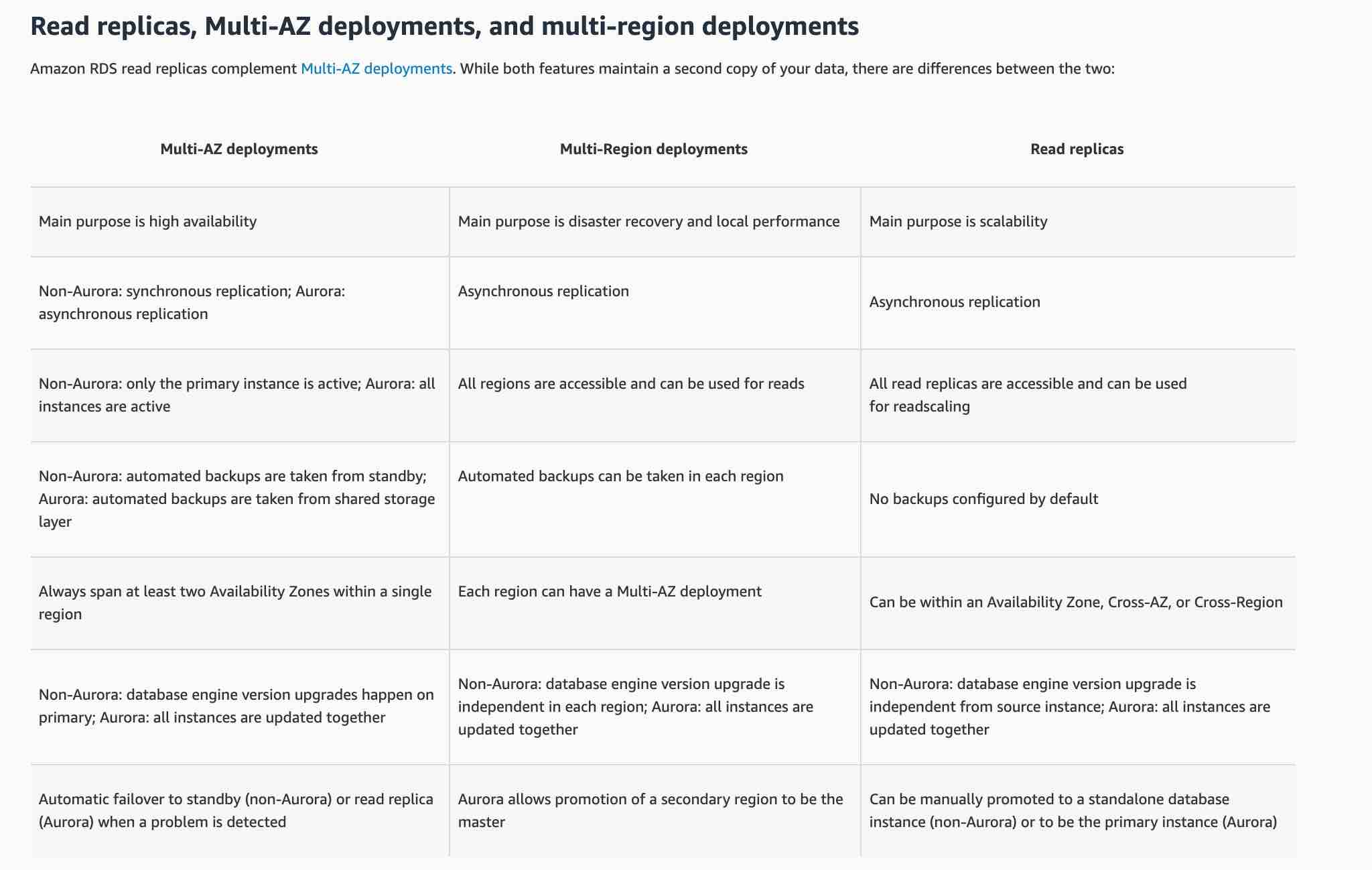
Enable RDS Multi-AZ - Amazon RDS Multi-AZ deployments provide enhanced availability and durability for RDS database (DB) instances, making them a natural fit for production database workloads. When you provision a Multi-AZ DB Instance, Amazon RDS automatically creates a primary DB Instance and synchronously replicates the data to a standby instance in a different Availability Zone (AZ). You cannot use Multi-AZ to improve the ETL process as it cannot use the standby instance as a source for the ETL process.
Exam Alert:
Please review the key differences between Read Replicas and Multi-AZ:
Upgrade the RDS instance type - Upgrade the RDS instance type may help a little bit, but the problem will resurface as traffic increases further. A better solution is to use the Read Replica as the source for the ETL process to populate the data lake on S3.
Use Athena to query RDS - Although Athena can query data from RDS by using its federated query feature, however, the problem would persist as the entire ETL load will fall on the main database. A better solution is to use the Read Replica as the source for the ETL process to populate the data lake on S3.
References:
https://docs.aws.amazon.com/AmazonRDS/latest/UserGuide/USER_ReadRepl.html
https://aws.amazon.com/rds/features/multi-az/
https://aws.amazon.com/blogs/big-data/query-any-data-source-with-amazon-athenas-new-federated-query/
Discussion
Think the marked answer is wrong, or have a better explanation? Share it below — comments appear after review.